

Image from Gov. Brian Kemp’s Twitter Account
After decades of fighting for fair voting processes, under a painting of a Georgia slave plantation, an all-White male caucus stood to watch Governor Brian Kemp sign a bill that can push the fight back decades.
Last week, the nation saw Republican lawmakers in Georgia quickly pass #SB202–now ironically called the Election Integrity Act of 2021. Overall, the bill creates barriers to voting in Georgia, with a particular focus on undermining communities of color–communities long known to be Democratic strongholds. Other very troubling provisions appear to be a direct attempt to seize control over local elections and making election administration even more partisian in the state.
Yet, the governor signed the bill despite mass public rebuke and pushback.
Throughout the week, the fallout over the bill continued into the business community.
Corporations headquartered in Georgia, including Delta Airlines and Coca-Cola, have since come out in opposition to the bill. There has also been significant pressure for more Georgia-based organizations to take a stand against the voting bill.
Today, Major League Baseball decided to move the 2021 All-Star game and 2021 MLB Draft.
The economic repercussions of signing #SB202 into law will more than likely continue to have a ripple effect on Georgia’s economy.
There are many provisions in the legisaltion that are anti-democracy.
Among many questionable provisions, one of the major components of this bill would give the republican led legislature the power to unseat local county elections boards. This provision could open the door for significant oversteps during elections, further compromising election integrity in the eyes of the public and jeopardizing the idea of free and fair elections.
According to the BBC,
Here’s what the new law does:
It adds new ID requirements for requesting mail-in ballots, replacing the current system which simply requires a signature.
- Republicans say this will instill greater confidence in election integrity, but Democrats say it will now be harder for working class people – who may not have an ID – to cast a ballot.
It expands early voting access in most counties.
- A previous version of the bill that curbed weekend voting prompted an outcry, with Democrats arguing it targeted the Sunday voting drives held by black churches.
It gives the state legislature greater power over the state election board.
- Democrats say the move would allow votes in certain counties to be thrown out, which Mr. Trump advocated for after his loss.
It bans the practice of giving food or water to voters in line.
- The Republican bill labels it a method of soliciting votes, but several media reports suggest that voters, particularly in majority black parts of the state, have often had to wait in line for hours.
It shortens the period for runoff elections.
- It will go from nine weeks to four weeks – shortening the time for early and mail in voting. Democrats say that is in an attempt to suppress votes after an energized voter base in Georgia sent two Democrats to the US Senate this year. Republicans say it will more fairly reflect voters’ beliefs at the time of the initial vote.
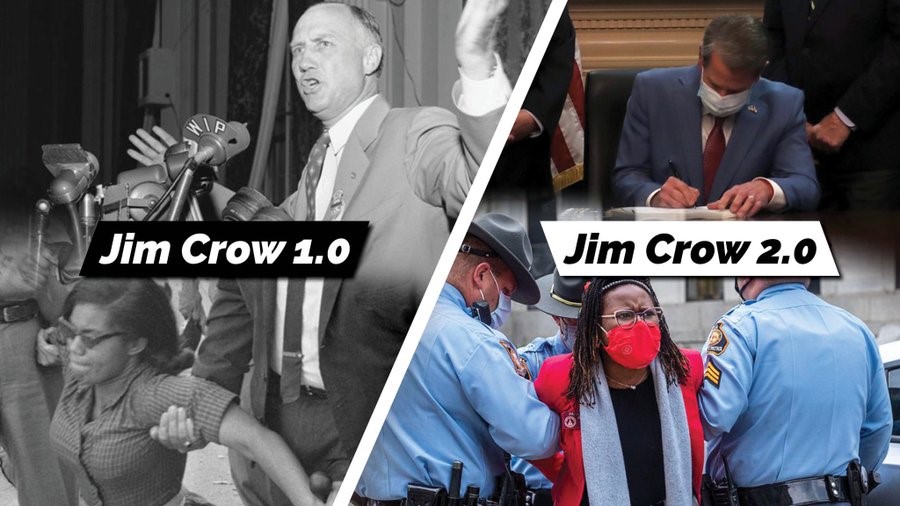
Since the Voting Rights Act of 1965 was signed into law by President Lyndon B. Johnson on August 6, 1965, there have been forces operating to render the law ineffective and suppress the rights of African Americans to vote. In 1965, President Johnson was surrounded by Dr. Martin L. King Jr. and other civil rights leaders as he signed the Voting Rights Act. However, there were not any Democrats nor Civil Rights leaders attending the ceremony when Governor Kemp signed #SB202.
It appears as though as African Americans- once again- we find ourselves depending on the Federal government to intervene and provide protection against a state government that would turn back the hands of time and deny its citizens a right that should be guaranteed for every citizen in a democracy the right to vote.
As the Gwinnett African American Caucus of the Democratic Party of Georgia, we vehemently oppose this and any legislation that would target, suppress, and deny the right to vote to a group of citizens based on their ethnicity or political affiliation. We further support all legal efforts to overturn this legislation and we call on our national representatives to pass HR1, For the People Act of 2021.
 Gwinnett African American Caucus